
Prompt Craft Tutorial: Write AI Prompts That Survive Real Work
A step-by-step prompt engineering tutorial with copy-paste templates for drafting, research, critique, and repetitive operations.
Bad prompts create busywork. Good prompts create repeatable leverage.
This tutorial teaches a prompt pattern you can reuse across ChatGPT, Claude, Gemini, and most coding assistants.
The 5-part prompt pattern
Every strong work prompt includes:
- Role — who the model should act like
- Objective — the finished artifact
- Context — only the facts that matter
- Constraints — tone, length, what to avoid
- Output format — exact structure you want back
If any piece is missing, quality drops.
Master template
Role: {{expert type}}
Objective: {{finished artifact}}
Audience: {{who will read/use this}}
Context:
- {{fact 1}}
- {{fact 2}}
Constraints:
- {{style / length / must-include / must-avoid}}
Output format:
- {{bullets / table / sections / JSON}}
Do not invent facts. If information is missing, ask up to 3 clarifying questions first.
Tutorial 1: Drafting a useful blog outline (10 minutes)
Prompt
Role: editorial strategist for an AI tools blog.
Objective: create an outline for a practical tutorial.
Topic: {{topic}}
Audience: beginners who are busy and skeptical of hype.
Constraints:
- Include a clear outcome in the intro
- Prefer steps over theory
- Add a mistakes section
- Keep SEO keywords natural
Output format:
1. Title options (3)
2. Meta description
3. H2/H3 outline
4. Internal link ideas
What “good” looks like: you can start writing immediately without another brainstorming session.
Tutorial 2: Research assist without fake citations (15 minutes)
Role: careful research assistant.
Objective: summarize what is known and unknown about {{topic}}.
Constraints:
- Separate verified facts, common claims, and open questions
- Do not invent citations
- Flag anything that needs primary-source checking
Output format:
| Claim | Confidence | How to verify |
Then: 5 follow-up search queries.
Use the table as a checklist. Click through and verify before you publish.
Tutorial 3: Critique and tighten your own draft (8 minutes)
Role: strict editor.
Objective: improve clarity and usefulness.
Paste draft below.
Constraints:
- No generic praise
- Preserve my voice
- Cut hype words
Output:
1. Top 5 problems
2. Line edits for the intro
3. A stronger checklist ending
Draft:
{{paste}}
Tutorial 4: Turn meetings into actions (5 minutes)
Role: chief of staff.
Objective: extract decisions and next actions from this transcript.
Constraints:
- Ignore small talk
- Mark owners and due dates when stated
- List unresolved questions separately
Output:
## Decisions
## Actions (owner · task · deadline)
## Risks
## Customer language worth saving
Transcript:
{{paste}}
Prompt library starter pack
Save these names in your notes app:
outline.v1draft.v1critique.v1research.v1meeting-actions.v1sop-from-notes.v1
Version them. When a prompt improves, bump v1 → v2 instead of overwriting blindly.
Evaluation checklist
Before you trust an AI answer, ask:
- Did it follow the output format?
- Did it invent specifics you did not provide?
- Can you verify the key claims in 5 minutes?
- Would you send this to a client after one edit pass?
If the answer to #4 is no, improve the prompt — do not just regenerate forever.
Common prompt mistakes
- “Write something good about AI tools” (no objective)
- Dumping an entire company wiki into every chat
- Asking for citations the model cannot reliably provide
- Accepting the first answer because it sounds confident
- Never saving the prompt that worked
Closing
Prompt craft is not magic language. It is product requirements writing for a model.
Use the 5-part pattern, keep a tiny prompt library, and judge outputs by whether they reduce your next hour of work. That is the difference between AI as entertainment and AI as infrastructure.
Related Articles
Keep exploring on AutoThinkers — these 7 guides pair well with this one:
- The Practical AI Toolkit for Solo Operators (2026)
- Tutorial: Build an AI Content Workflow in 60 Minutes
- AI for Students: How to Study Smarter with ChatGPT, Claude & Free AI Tools (2026 Guide)
- AI for Small Business: A Practical Playbook That Pays for Itself
- The Attention Budget: Why Deep Thinkers Treat Focus Like Capital
- Designing Personal Systems That Survive Contact With Real Weeks
- Lattice Thinking: How to Connect Ideas Without Drowning in Notes
- Best ChatGPT Prompts for Students
- ChatGPT vs Claude vs Gemini: Which AI Should You Use in 2026?
- Best AI Productivity Tools in 2026 (Practical Stack That Saves Hours)
- Microsoft Copilot vs ChatGPT (2026): Which Should You Use?
- Perplexity vs ChatGPT (2026): Which AI Should You Use?
Keep exploring
Related Articles
Continue with 8 closely related AutoThinkers guides — more tutorials to deepen your AI workflow.
Prompt Craft
5 min read
Best ChatGPT Prompts for Students (2026 Copy-Paste Library)
The best ChatGPT prompts for students — study plans, note summaries, practice quizzes, essay outlines, and exam prep templates you can copy today.
AI Tools
5 min read
How Small Businesses Can Use ChatGPT (Practical 2026 Guide)
How small businesses can use ChatGPT for customer replies, marketing drafts, SOPs, and admin work — with copy-paste prompts and a safe weekly workflow.
AI Tools
6 min read
AI for Small Business: A Practical Playbook That Pays for Itself
A clear guide to using AI in a small business — where to start, which tasks to automate first, copy-paste prompts, and a 30-day rollout plan.

Tutorials
5 min read
Tutorial: Build an AI Content Workflow in 60 Minutes
A complete beginner-friendly workflow to research, draft, edit, and publish content with AI — including prompts, checkpoints, and a one-hour setup plan.
Tutorials
6 min read
Free AI Homework Helpers That Actually Work (2026 Student Guide)
Free AI homework helpers that actually help you learn — ChatGPT, Claude, Gemini, Photomath-style tools, and study workflows — plus academic integrity rules.
Comparisons
6 min read
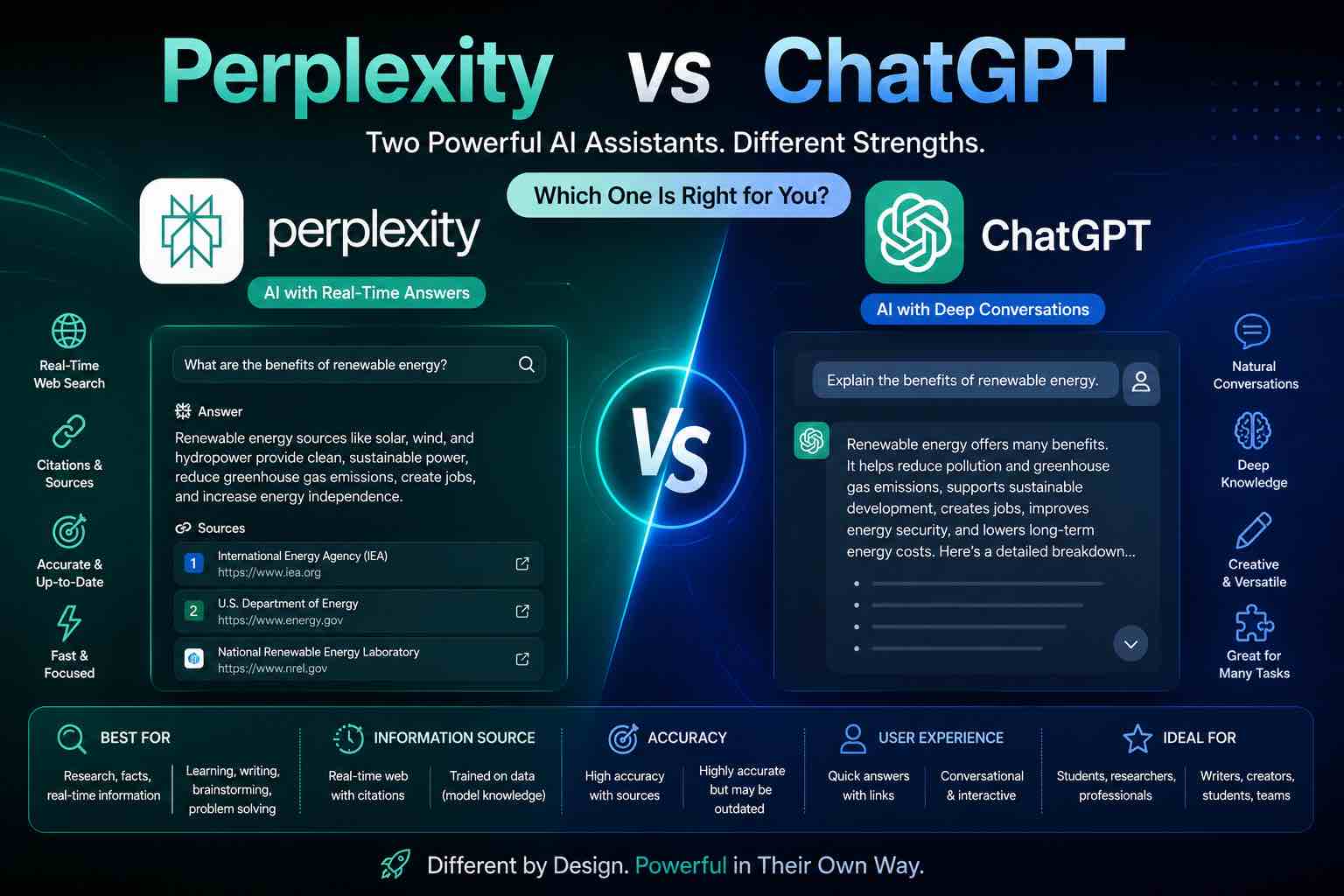
Perplexity vs ChatGPT (2026): Which AI Should You Use?
Perplexity vs ChatGPT compared for research, citations, writing, and everyday work — when to search with sources, when to draft, and which to pick first.

Comparisons
5 min read
ChatGPT vs Claude vs Gemini: Which AI Should You Use in 2026?
A clear ChatGPT vs Claude vs Gemini comparison for work, study, and content — strengths, weaknesses, pricing mindset, and which model to pick first.

Systems Thinking
5 min read
Designing Personal Systems That Survive Contact With Real Weeks
Most personal operating systems die by Wednesday. Here is how to design workflows that bend under load instead of shattering.